

Valley Stream drivers face a decisive choice between electric vehicles (EVs) and hybrids. This guide explains the key differences, benefits, and practical considerations for Toyota’s electric and hybrid models in 2026.

Valley Stream drivers face a decisive choice between electric vehicles (EVs) and hybrids. This guide explains the key differences, benefits, and practical considerations for Toyota’s electric and hybrid models in 2026. It compares the operating principles of the bZ4X and traditional hybrids such as the Prius and RAV4 Hybrid, identifies models suited to local driving conditions, examines seasonal effects on performance, and reviews cost, charging infrastructure, and ownership considerations relevant to Valley Stream residents.
Toyota’s electric vehicle strategy includes ambitious production targets and ongoing adaptation to a competitive global market.
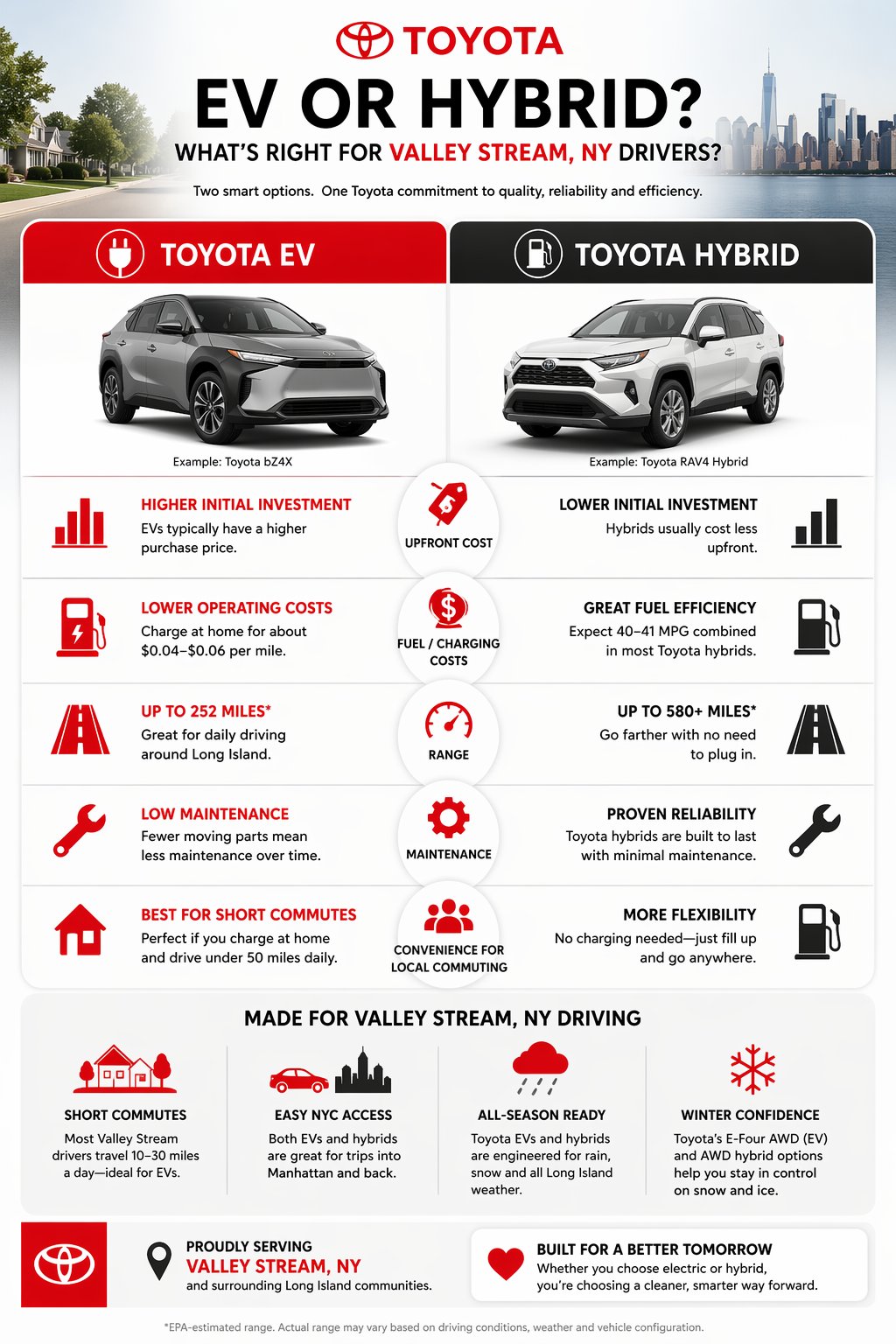
Toyota electric vehicles and hybrids represent two distinct approaches to lower-emission driving. EVs such as the bZ4X run only on electric power, using a battery pack and an electric motor to achieve zero tailpipe emissions. Hybrids pair a gasoline engine with an electric motor to increase flexibility and fuel efficiency. This operational difference results in measurable variations in performance, energy use, and environmental impact.
Beyond propulsion, the ownership experience differs. EV owners generally interact more with charging routines and software-driven range management, while hybrid owners typically experience more familiar refuelling habits and incremental fuel savings. Driving character varies as well: EVs often feel brisk from a stop because of instant electric torque, whereas hybrids deliver a blended, efficient delivery of power designed for steady economy. These contrasts influence daily convenience, maintenance rhythms, and buyer expectations.
The bZ4X uses an electric motor driven by a rechargeable battery pack to deliver immediate torque and a smooth drive. Hybrid models combine a gasoline engine with an electric motor and switch between power sources to optimise fuel efficiency and lower emissions. EVs provide all-electric range, while hybrids offer versatility for longer trips without frequent recharging.
In everyday use the bZ4X emphasises quiet operation and predictable acceleration. Regenerative braking recovers energy during deceleration and can change the feel of city driving through enhanced energy recapture, sometimes allowing single‑pedal driving in routine traffic. Charging habits are a new routine for many buyers: overnight home charging covers typical daily mileage for most suburban drivers, while public chargers supplement longer journeys. These practical behaviours shape whether an EV feels like an improvement or an added task for a given household.
Toyota continues to advance powertrain and battery technologies to enhance EV performance and safety.
Toyota BEV Powertrain & Battery Innovations
Toyota’s new BEV incorporates recent advances in powertrain systems and platform design. It uses newly developed large-format battery cells to meet performance and safety targets while improving energy density and reducing battery deterioration. For battery cooling, the cooling plate and cells are separated by a chamber structure to enhance safety. The battery pack employs a high-resistance coolant with low conductivity. The BEV also improves system efficiency by adapting technologies from HEV development and introducing new systems. Features such as radiant heating and an advanced heat pump system contribute to improved EV driving range. This presentation outlines the new battery technologies and the BEV system.
Development of powertrain system and battery for BEV, 2023
Toyota hybrid models, including the Prius and RAV4 Hybrid, use technologies designed to improve efficiency and performance. Key systems include regenerative braking, which recovers energy during braking to recharge the battery, and the Toyota Hybrid Synergy Drive, which integrates the gasoline engine and electric motor for seamless operation. These features enhance fuel economy and reduce emissions.
Hybrid systems also emphasise proven durability and predictable maintenance needs. Battery packs in hybrid models are generally smaller and designed for frequent shallow cycling rather than long pure-electric range; this can translate into steady long-term performance in mixed driving conditions. Servicing tends to align with established dealer schedules, and many owners report a familiar ownership pattern with the added benefit of improved city fuel economy.
Several Toyota models are well suited to Valley Stream driving in 2026 based on performance and local needs. The 2026 Toyota Prius, with a starting price of $28,550, delivers strong fuel efficiency and a spacious cabin for daily commutes. The 2026 RAV4 Hybrid, priced at about $31,900, combines versatility and hybrid efficiency for families and active users. For drivers prioritising all-electric operation, the 2026 bZ4X provides modern design and advanced technology targeted at eco-conscious buyers.
When choosing between these models consider passenger and cargo needs, typical trip length, and storage for charging equipment. The Prius will often appeal to commuters focused on maximum fuel economy and compact manoeuvrability, while the RAV4 Hybrid offers additional cargo room and ride height for weekend gear. The bZ4X suits drivers who prioritise emissions-free local travel and the convenience of home charging; buyers with frequent longer-distance travel may prefer the hybrid's refuelling flexibility.
The bZ4X offers an approximate range of 250 miles per charge and includes a roomy interior, advanced safety systems, and a user-friendly infotainment suite. These characteristics position the bZ4X as a competitive EV choice for Valley Stream drivers seeking sustainable transportation.
Practical features that affect daily usability include cargo layout, available drive modes that tune regeneration, and in-car trip planning tools that route through charging points. Drivers who plan irregular long trips should familiarise themselves with public charging networks and routing tools offered in the vehicle’s navigation system. For most suburban commutes, the stated range combined with routine charging will be sufficient for several days of driving without visiting a public charger.
Toyota hybrids address diverse local driving requirements by switching between electric and gasoline power. Models such as the Prius and RAV4 Hybrid perform well in urban stop-and-go traffic and deliver notable fuel savings for local trips. Many hybrid variants also offer all-wheel drive (AWD) options to improve traction and capability in varied weather.
Seasonal weather affects both EV and hybrid performance. Cold conditions can reduce EV battery efficiency and lower driving range. Hybrids may show changes in fuel economy but retain the gasoline engine as a supplementary power source. Awareness of these effects helps drivers choose the appropriate vehicle for winter conditions.
Owners can mitigate some cold-weather effects through routine practices. Preconditioning the cabin and battery while the vehicle is plugged in, using scheduled charging to finish before departure, and moderating aggressive driving during cold spells all help preserve usable range. Similarly, using climate control settings efficiently and ensuring tires are properly inflated for winter conditions contribute to predictable performance for both EVs and hybrids.
In cold weather, hybrids can offer greater operational reliability because the gasoline engine provides a backup power source when battery performance declines. Hybrids also tend to preserve fuel efficiency better in lower temperatures, which can make them a practical choice for winter driving in Valley Stream.
Cold temperatures can slow EV charging rates and reduce usable battery capacity, which may increase range concerns for owners. Valley Stream drivers should consider charging station availability and winter charging behaviour to maintain reliable vehicle operation during colder months.
Cost comparisons should account for purchase price, maintenance, expected fuel savings, and available incentives. Evaluating these elements side by side helps Valley Stream residents determine the most financially sound option for their circumstances.
Insurance, local electricity costs, and any expenses related to home charging installation will also affect total cost of ownership. Insurance premiums for EVs may differ from hybrids in some cases because repair procedures and component replacement can vary; prospective buyers should obtain quotes for each vehicle type they consider. Factoring in available federal and state incentives, and estimating likely annual energy or fuel costs for personal driving patterns, produces a clearer comparison for budgeting.
Purchase prices vary by model: the 2026 Toyota Prius starts at $28,550 and the 2026 RAV4 Hybrid is approximately $31,900. The 2026 bZ4X is positioned as a premium electric option. Hybrids generally have lower maintenance costs than comparable traditional gasoline vehicles, while EVs typically have fewer moving parts, which can reduce maintenance expenses over the vehicle’s life.
Valley Stream drivers can realise fuel savings with hybrids and eliminate gasoline costs with EVs. New York State offers incentives for electric vehicle purchases, including tax credits and rebates, which can reduce upfront costs and improve the total cost of ownership.
| Model | Type | Price |
|---|---|---|
| 2026 Toyota Prius | Hybrid | $28,550 |
| 2026 Toyota RAV4 Hybrid | Hybrid | Approximately $31,900 |
| 2026 Toyota bZ4X | Electric | Price TBD |
This table shows price differences among common Toyota models to help Valley Stream drivers evaluate options by budget and preference.
Charging infrastructure is a key factor for potential EV owners. Valley Stream has a growing network of public charging stations that improve charging convenience for residents.
For many homeowners, a dedicated Level 2 wall box installed at the residence will provide the most convenient daily charging experience. Installation typically involves coordinating with an electrician, reviewing parking access, and checking whether local housing rules or homeowner associations have specific requirements. Planning ahead for a home charger both simplifies daily recharging and reduces reliance on public stations for routine driving.
Charging stations are located throughout Valley Stream, often near shopping centres and public amenities. These placements make charging accessible during routine activities and support a gradual transition to electric vehicles for local drivers.
Charging times depend on the level of charging. Level 1 charging using a standard household outlet can take up to 24 hours for a full charge. Level 2 public or home chargers typically restore charge in about 4–8 hours. DC fast chargers can deliver an 80% charge in roughly 30 minutes, which is useful for longer trips.
Drivers should weigh cost, maintenance requirements, range, charging access, and environmental impact when selecting between an EV and a hybrid.
Range anxiety is a common factor for EV buyers, especially where charging options are limited. Knowing the real-world range of models such as the bZ4X and local charging availability can reduce concern. Hybrids provide flexibility through their gasoline engine, removing the need for frequent recharging on long trips.
Toyota EV battery life is commonly estimated at 8–10 years depending on usage and climate. Toyota provides warranties that cover battery performance for EVs and hybrid batteries, offering owners additional assurance regarding long-term reliability.
Battery longevity can be supported through modest charging habits such as avoiding prolonged full charges and maintaining moderate state-of-charge targets during daily use where practical. Regular software updates from the manufacturer and periodic battery health checks at service intervals also help maintain long-term performance. These routine steps, combined with warranty coverage, contribute to predictable ownership outcomes.
Commute patterns and trips to New York City influence the optimal vehicle choice. Consider trip length, traffic type, and access to charging when evaluating EVs versus hybrids.
Toyota EVs such as the bZ4X suit both suburban and urban driving. Their electric range covers typical short commutes, and urban charging availability supports longer trips. The quiet operation of EVs is an added benefit in residential areas.
For regular commuters to NYC, hybrids can be advantageous. Their combined powertrain delivers efficient performance in stop-and-go traffic, and some hybrid models may qualify for HOV lane access, which can reduce commute time during peak periods.
Travel habits matter: drivers who regularly face long, uninterrupted highway segments or who lack reliable overnight charging may find hybrids reduce planning friction. Conversely, those with predictable daily mileage and easy access to home or workplace charging can capture the majority of EV benefits. Running through a few real-world scenarios—daily commute, weekly long trips, multi-day travel—can clarify which powertrain best matches a household’s lifestyle.
Local resources provide reliable information and support for purchasing Toyota EVs and hybrids. Prospective buyers should consult dealers, official manufacturer information, and local incentive programmes.
Advantage Toyota maintains an online inventory, offers financing options, and provides customer support. Their staff can answer questions about specific models, features, and available incentives to help buyers make informed decisions.
Structured data and clear FAQs improve buyer confidence by delivering concise information on specifications, pricing, and incentives. Transparent details help buyers assess options and make informed choices in a changing market.
For detailed information on Toyota's hybrid technology, the Toyota Hybrid Synergy Drive provides comprehensive explanations of how these systems improve fuel efficiency and performance.
Valley Stream drivers exploring electric vehicle incentives can consult the New York State Clean Vehicle Rebate Project for details on available rebates and tax credits.
For practical information on owning a Toyota bZ4X, including charging and maintenance, refer to the official Toyota bZ4X page for specifications and owner resources.
Deciding between a Toyota EV and a hybrid ultimately comes down to matching vehicle capability with personal driving patterns and priorities. Test-driving both powertrains, reviewing local charging and parking realities, and discussing financing and incentive options with a dealer will provide the most practical basis for selection. For many Valley Stream drivers, a careful side-by-side evaluation clarifies which choice delivers the best balance of convenience, cost, and environmental benefit.
EVs such as the bZ4X produce no tailpipe emissions, which reduces local air pollutants and greenhouse gas emissions. Hybrids still use gasoline and therefore emit pollutants. Selecting an EV lowers direct vehicle emissions, a benefit that increases as the electricity grid incorporates more renewable energy.
Resale values for Toyota EVs depend on battery condition, technological changes, and market demand. Hybrids have historically retained strong resale values due to fuel efficiency. As the used EV market and charging infrastructure mature, resale values for models like the bZ4X are expected to strengthen.
Valley Stream provides multiple charging options. Level 1 charging via a standard home outlet is convenient but slow, potentially taking up to 24 hours for a full charge. Level 2 chargers at public locations typically recharge in 4–8 hours. DC fast chargers can restore about 80% charge in roughly 30 minutes for quick long-distance stops.
Toyota hybrids like the Prius and RAV4 Hybrid surpass many traditional gasoline vehicles in fuel efficiency by combining a gasoline engine with an electric motor. This integration optimises energy use and often yields substantially higher miles per gallon in city driving, which lowers fuel costs and emissions.
New York offers incentives to support EV and hybrid purchases, including state tax credits and rebates through the Clean Vehicle Rebate Project, along with possible local programmes. Some incentives also subsidise home charging station installation, reducing the overall cost of ownership.
EVs generally require less routine maintenance because they have fewer mechanical components and do not need oil changes; however, battery health monitoring is essential. Hybrids require maintenance for both the gasoline engine and the electric system. Both vehicle types benefit from Toyota’s warranty coverage for battery performance, which supports long-term ownership confidence.
Drivers should evaluate charging infrastructure, daily driving patterns, range requirements, and expected savings on fuel and maintenance. Reviewing available incentives and learning features such as regenerative braking and energy management systems will help optimise the ownership experience.
