

Toyota is expanding its electric vehicle (EV) range with models such as the Toyota bZ. This electric SUV combines performance, modern technology, and environmental advantages relevant to drivers in Valley Stream, NY.

Toyota is expanding its electric vehicle (EV) range with models such as the Toyota bZ. This electric SUV combines performance, modern technology, and environmental advantages relevant to drivers in Valley Stream, NY. The following content reviews the bZ’s key features, electric range, and performance in local weather, and also examines Toyota’s hybrid models, regional charging infrastructure, and ownership benefits to support informed purchase decisions. Readers will find practical guidance for everyday use, suggestions for charging and maintenance, and guidance on working with local dealers to evaluate options and incentives.
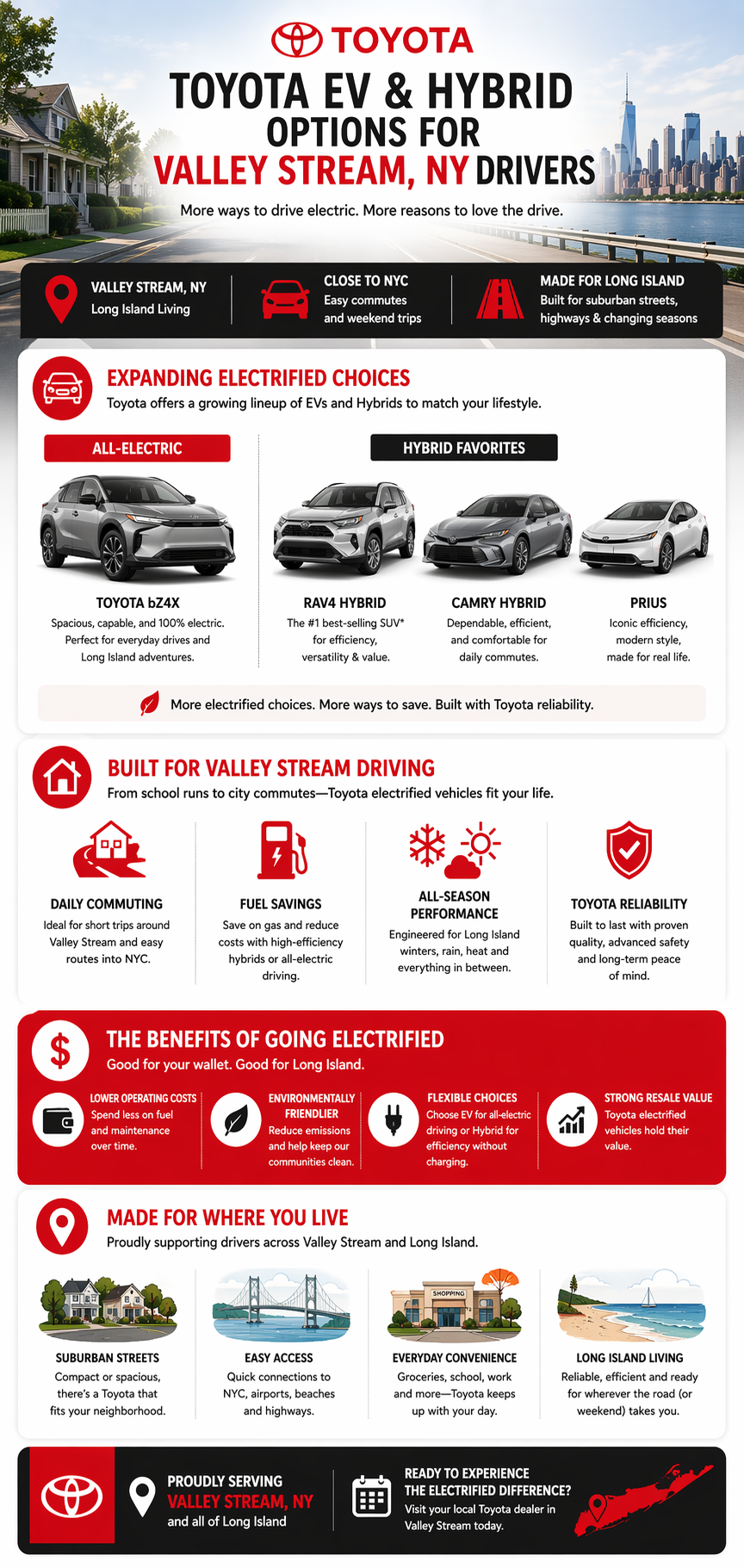
The bZ pairs contemporary EV engineering with practical features for local drivers. With a starting MSRP of $37,490, the FWD configuration delivers up to 252 miles of range, suitable for daily commutes and extended trips. An available AWD system with Toyota’s X-MODE improves traction in varied conditions. The model also includes a large touchscreen, smartphone integration, and advanced safety systems to provide a modern and connected driving experience. Interior layout and cargo versatility are designed to suit family errands and routine commuting needs, while driving mode options help balance comfort and efficiency depending on trip type.
Range and charging capability are key considerations for buyers. The bZ XLE FWD achieves up to 252 miles of electric range. For charging, the vehicle supports Level 2 charging with an enhanced 11‑kW onboard charger, enabling efficient charging at home or at public stations to keep the vehicle ready for regular use. Many owners supplement home charging with occasional public DC fast charging when longer trips require quick top-ups; public fast chargers can substantially cut charging time for on-the-road stops and are increasingly available at shopping centers and highway corridors.
Toyota’s engineering incorporates battery and powertrain innovations that contribute to the bZ’s electric range and operational efficiency.
Valley Stream experiences seasonal variation that can affect vehicle performance. The bZ is engineered to perform reliably in these conditions, particularly when equipped with AWD and X-MODE, which enhance traction on slippery surfaces. Battery efficiency can decline in very low temperatures, which may reduce range in winter months. Awareness of these effects helps drivers assess real-world range and plan accordingly. Practical steps such as preconditioning the cabin while the vehicle is plugged in, using tire types suited for winter conditions, and moderating rapid acceleration can help preserve usable range during cold snaps.
Toyota provides several hybrid models suited to suburban commuting. The 2023 RAV4 Hybrid, with a starting price of $30,725, offers an EPA-estimated 41 MPG city and 38 MPG highway. The 2023 Highlander Hybrid, starting near $39,555, delivers a spacious interior and competitive fuel economy for family use. These hybrids balance performance with efficiency for typical suburban travel patterns. Hybrids are particularly effective in stop-and-go traffic where electric assistance and regenerative braking capture energy and improve city fuel economy, and they require few changes to driver habits while delivering meaningful savings.
The Prius and RAV4 Hybrid are recognised for fuel economy and long-term reliability. The 2023 Prius achieves an EPA-estimated 57 MPG city and 56 MPG highway. The 2023 RAV4 Hybrid provides an EPA-estimated 41 MPG city and 38 MPG highway. Both models benefit from Toyota’s established reliability standards, supporting dependable ownership over time. Owners frequently cite straightforward maintenance practices and wide parts availability as factors that keep long-term ownership costs predictable, and regular servicing at certified facilities helps retain resale value.
Toyota’s hybrid systems provide advantages in cold conditions by combining a gasoline engine with an electric motor. The electric motor assists during acceleration, reducing engine load and improving fuel economy in low temperatures. Hybrid systems are also configured to maintain battery performance across a range of climates, supporting consistent operation year-round. In practice, hybrids can warm the cabin quickly using engine heat while continuing to capture efficiency benefits in mixed driving, and scheduled climate controls or preconditioning can make cold-season driving more comfortable while limiting range impacts.
Charging infrastructure is a practical consideration for EV ownership. In Valley Stream, charging stations are available in public parking facilities, shopping centres, and along major thoroughfares, providing convenient options for charging during errands or commutes. The expanding network of stations supports the increasing number of EVs and improves access to charging when required. Most public stations accept common payment methods and can be located via mobile apps or navigation systems; drivers should also be aware of connector types (for example, Level 2 plugs and various DC fast-charger standards) to ensure compatibility for on-the-road charging.
Charging locations along the Southern State and Meadowbrook Parkways assist drivers on longer commutes by offering opportunities to recharge during trips. This roadside infrastructure increases the practicality of EV ownership and reassures drivers that charging options are accessible during regional travel. Using real-time station data and planning stops around errands or meal breaks makes it easy to fit charging into a commute without creating significant detours, and checking station hours or parking rules ahead of time reduces surprises.
Toyota’s electric and hybrid models reduce fuel consumption and emissions compared with conventional gasoline vehicles. This reduction lowers operating costs for owners and contributes to improved local air quality. As adoption increases, the cumulative environmental benefit for Valley Stream and surrounding communities becomes more significant. Beyond emissions reductions, EVs and hybrids often produce less engine noise, which can improve the quality of life in residential areas and near schools.
Toyota hybrids deliver measurable fuel savings relative to standard gasoline vehicles. For example, the 2023 Prius’s fuel economy can yield annual fuel cost reductions amounting to several hundred dollars compared with a conventional vehicle. The RAV4 Hybrid’s efficiency also produces notable savings for frequent commuters and long-distance drivers, enhancing overall cost of ownership. Individual savings vary based on driving patterns, local fuel and electricity prices, and maintenance habits; factoring in reduced fuel purchases and lower routine service needs often shows hybrids as a cost-effective choice for many suburban drivers.
Reduced tailpipe emissions from EVs and hybrids improve air quality in urban and suburban areas. The bZ produces zero tailpipe emissions, while hybrids lower overall emissions through electric assistance. Increased adoption of these vehicles supports public health objectives and contributes to a more sustainable local environment. Over time, lower emissions can reduce exposure to pollutants in densely populated corridors and around schools, which yields health and quality-of-life benefits for local residents.
Local climate influences EV and hybrid performance, particularly regarding battery behaviour in cold conditions. Toyota’s engineering addresses these challenges through features that optimise performance across temperature ranges. Understanding these design measures helps drivers evaluate vehicle suitability for local conditions. Routine checks, such as monitoring battery health at service visits and following manufacturer guidance on charging and storage, help preserve performance and reliability year-round.
Cold temperatures can reduce battery performance and electric range. Hybrid models mitigate this impact by engaging the gasoline engine as needed to preserve efficiency and performance. The combined systems enable drivers to retain practical usability of hybrid vehicles during winter months. Simple practices—parking in a garage when possible, scheduling charging to finish shortly before departure, and minimizing heavy loads like roof racks—can help retain usable range during colder periods.
Toyota applies thermal management and related technologies to maintain optimal battery temperatures and consistent performance in varied weather. The availability of AWD in models such as the bZ further enhances traction and vehicle stability during adverse conditions, supporting driver confidence. Features such as cabin preconditioning and intelligent thermal controls reduce the need for extreme battery draw for heating or cooling, helping maintain usable range while improving comfort.
Practical planning improves highway travel with EVs and hybrids. Drivers should note charging station locations on planned routes and factor vehicle range into travel plans. Advance planning reduces the likelihood of unexpected charging needs and supports a smoother journey. When possible, select efficient driving modes, use cruise control where appropriate, and monitor the vehicle’s energy consumption readouts to maximize range on longer drives.
Toyota’s EV and hybrid powertrains are capable of sustained highway operation while maintaining strong fuel economy. The combination of electric and gasoline power provides smooth acceleration and responsive handling, making these vehicles suitable for daily commuting on regional parkways. For frequent highway driving, paying attention to tire pressure, minimizing unnecessary weight, and using aerodynamic accessories sensibly will help maintain efficiency.
Effective charging strategies include identifying charging stations along the route, planning stops according to range and charging times, and using apps that report real-time station availability. These measures help ensure efficient and timely recharging during extended travel. For public fast chargers, many drivers follow the practice of charging to roughly 80 percent for the fastest overall charge rate and then topping up later as needed; on long trips, incorporating a series of shorter, strategic stops can be faster than waiting for a single full charge.
Local incentives can reduce the cost of EV and hybrid ownership. Potential programs include state and local tax credits, rebates, and finance incentives. Utility companies may also offer incentives for home charger installation. Reviewing available programmes can lower upfront costs and total cost of ownership. Buyers should confirm eligibility rules and application timelines for each programme, and consider combining utility incentives with dealer promotions where allowable.
Dealerships such as Advantage Toyota offer competitive financing and local promotions that can improve affordability. Exploring these offers can help drivers identify payment plans and incentives that align with their budget and mobility requirements. Discussing trade-in value, warranty options, and service packages with dealership staff can further clarify total cost of ownership and highlight opportunities to tailor a purchase to individual needs.
Advantage Toyota provides a broad inventory of Toyota’s current models and delivers customer support throughout the purchase process. The dealership supplies resources and information on electric and hybrid technology to help buyers compare options and make evidence-based decisions. Customers can typically request test drives and ask for demonstrations of charging equipment and in-vehicle technology to better understand how a model will fit into day-to-day life.
Advantage Toyota’s staff offer model-specific knowledge to assist customers in assessing features and selecting vehicles that meet their needs. The dealership also provides ongoing support for maintenance and charging enquiries to facilitate a positive ownership experience. Technicians trained on Toyota’s electrified systems can handle diagnostics, software updates, and any manufacturer-recommended checks to keep vehicles operating as intended.
Ongoing service is essential for EV and hybrid ownership. Advantage Toyota offers specialised services, including battery checks and software updates, and provides guidance on local charging options to help owners maintain vehicle performance and reliability. Service centers can advise on home charger installation considerations, recommend qualified electricians when needed, and help owners understand recommended maintenance intervals for non-propulsion systems such as brakes, tires, and climate controls.
The bZ is an all-electric vehicle that operates solely on electric power and therefore produces zero tailpipe emissions, unlike gasoline vehicles that burn fossil fuel. This difference results in lower operating costs from reduced fuel consumption and simplified maintenance. The bZ also features systems such as regenerative braking and delivers a quieter driving experience. In many cases, EVs qualify for incentives that improve their long-term financial proposition. Buyers should consider charging access and home electrical capacity as part of the comparison to ensure the EV fits their lifestyle.
The bZ competes on range, performance, and technology. With up to 252 miles of range, available AWD and X-MODE for enhanced traction, and Toyota’s established service network, it offers a balanced option in the electric SUV segment. The model’s battery innovations support longevity and efficiency, providing a competitive ownership profile. When comparing models, consider factors such as in-cabin features, warranty coverage, dealer service experience, and available charging infrastructure for your typical routes.
For home charging, a Level 2 charger is recommended to reduce charging time, typically requiring about 7–9 hours for a full charge. Confirm that the home electrical system can support the chosen charger and plan the charger location for convenience and safety. Scheduling charging during off-peak hours can lower electricity costs. Regular inspection of cables and connections supports safe operation. For installation, consult a licensed electrician to evaluate panel capacity, permit requirements, and the best mounting location to ensure reliable weekly charging.
Maintenance differs from hybrids primarily because the bZ lacks a gasoline engine. Key items include monitoring battery coolant and overall battery health, ensuring the charging system functions correctly, and maintaining tires and brakes. Software updates may be required periodically. Overall, EVs tend to incur lower routine maintenance than conventional vehicles. Owners should still follow manufacturer service recommendations for inspections that preserve warranty coverage and long-term performance.
Driving a bZ or hybrid reduces greenhouse gas emissions relative to conventional gasoline vehicles. The bZ produces no tailpipe emissions, improving local air quality. Hybrids lower overall fuel consumption by utilising electric assist, which reduces emissions. Choosing these vehicles supports the transition to lower-emission transportation. Combined with renewable electricity where available, EVs can further reduce lifecycle emissions associated with personal transportation.
Locate local incentives by consulting state and municipal government websites for rebates, tax credits, and grants. Utility providers may offer incentives for charger installations. Dealerships such as Advantage Toyota can provide current information on promotions and financing. Participation in local EV forums can also reveal additional programmes and practical advice. Keep documentation of purchases and installations handy when applying for rebates or incentive programmes to streamline the process.
The bZ battery is typically expected to last around eight to ten years, depending on use and maintenance practices. Toyota’s battery design aims to reduce degradation and improve durability. Proper charging practices and thermal management can extend service life, and Toyota provides battery warranties to address potential issues during the warranty period. Prospective buyers should review warranty terms and follow recommended charging and storage guidance to maximise longevity.
