

This guide examines the practical considerations of owning an electric vehicle (EV) in Valley Stream, NY, with a focus on Toyota models. It reviews cost differences between EVs and hybrids, available local incentives, and winter performance in New York.

This guide examines the practical considerations of owning an electric vehicle (EV) in Valley Stream, NY, with a focus on Toyota models. It reviews cost differences between EVs and hybrids, available local incentives, and winter performance in New York. The content is intended to help buyers evaluate benefits and trade-offs and to explain how local resources, including Advantage Toyota, can support the purchase process. Use this guide as a decision aid: compare ownership patterns, expected driving distance, and access to charging to match a model to your needs.
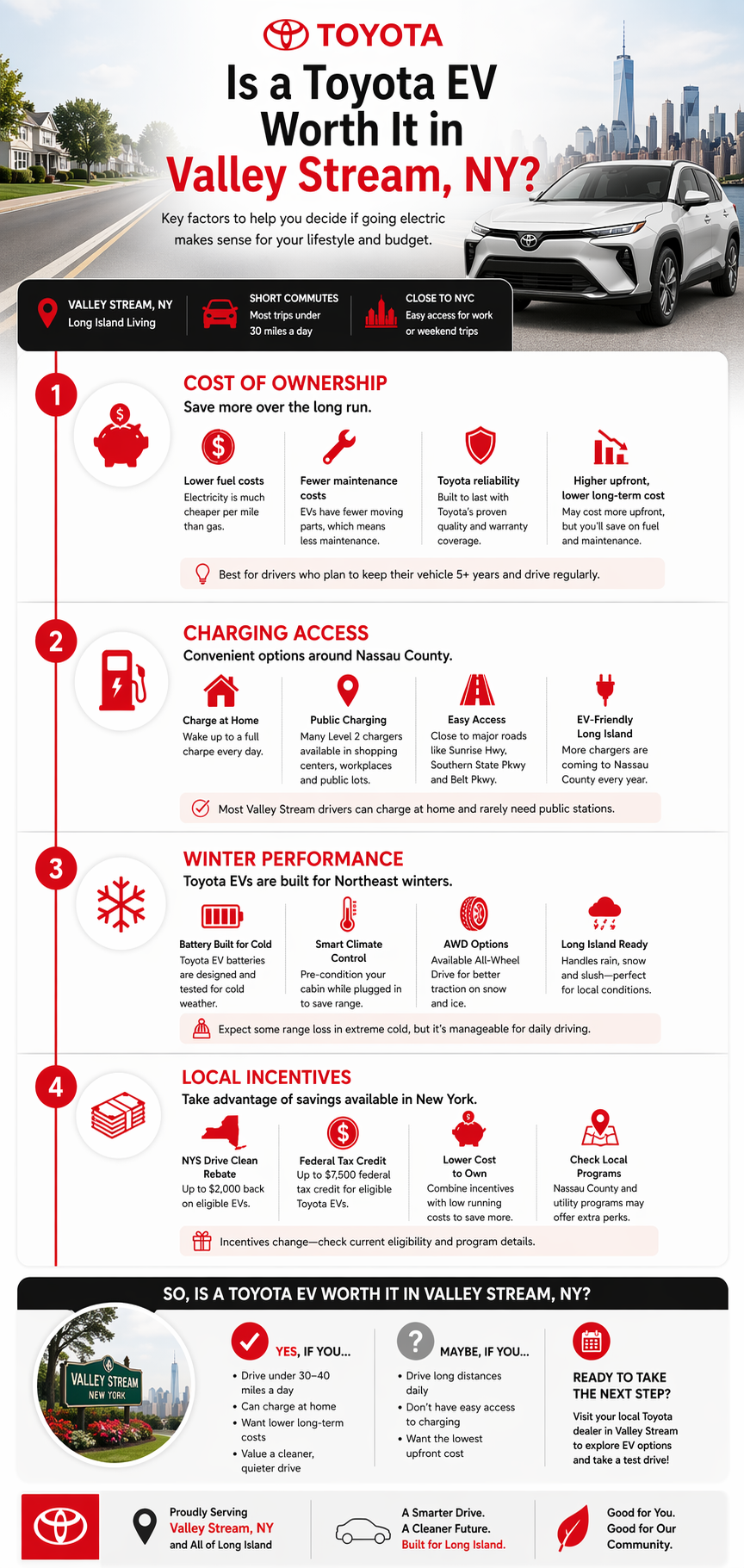
These points summarise the most relevant considerations for Valley Stream residents thinking about a Toyota EV or hybrid; read the sections below for practical steps and owner-focused guidance.
Evaluating the financial implications requires considering purchase price, fuel costs, and maintenance. EVs typically cost more at purchase but often deliver lower operating costs over time. Buyers in Valley Stream should weigh upfront expense against expected savings in electricity and reduced service requirements. When comparing models, create a simple multi-year total cost of ownership (TCO) estimate that includes estimated electricity versus gasoline spend, expected maintenance items, insurance differences, and likely resale value to make an apples-to-apples comparison.
Ownership costs vary by model and usage, but common trends are clear. The Toyota bZ4X and similar EVs usually have higher initial prices than hybrids, yet lower fuel costs because electricity often costs less than gasoline. EVs also tend to need fewer mechanical repairs due to simpler drivetrains, which can improve total cost of ownership over several years. To estimate your own costs, track typical monthly mileage, estimate home charging frequency, consider workplace charging access, and include periodic service items such as tires and inspections.
Existing research indicates that higher initial purchase prices can be offset by lower fuel and maintenance expenses when evaluated over a multi-year ownership period.
Long-term maintenance for EVs is generally lower than for hybrids. Toyota’s electric models are engineered for durability, which can reduce repair frequency and associated costs. Hybrids, because of their combined powertrains, may require more routine service over time, affecting total ownership expense. Typical EV maintenance still includes items such as tyre rotations, brake inspections, cabin air filters, and software updates; owners should budget for periodic checks on battery health and keep records of regular service to preserve resale value.
New York State and local governments offer financial incentives to support EV adoption. These rebates and programs can reduce purchase costs and improve the affordability of electric vehicles for residents of Valley Stream. Incentives often change over time, so verifying current program details before purchase is important; dealerships can assist with up-to-date information.
Toyota buyers may qualify for programs such as the Drive Clean Rebate, which offers up to $2,000 for eligible EV purchases. Nassau County provides additional local incentives that can further lower the net cost. These programs aim to make cleaner transportation more accessible. In addition to state and county support, some buyers may be eligible for federal incentives or tax credits depending on vehicle and purchaser eligibility; confirm which combinations apply and whether incentives require separate applications or are handled at point of sale.
Studies of incentive programs show they can reduce financial barriers and encourage broader EV adoption when properly targeted.
State, local, and federal incentives can combine to lower the effective purchase price by several thousand dollars. For many buyers in Valley Stream, these savings make models such as the Toyota bZ4X more attainable. Prospective purchasers should confirm eligibility and stacking rules to maximise available benefits. When budgeting, consider whether incentives apply to purchases, leases, or both, whether they are point-of-sale rebates or tax credits, and whether the dealer can assist with filing or provide documentation for applications.
Charging infrastructure is a key factor in EV ownership. Nassau County has been expanding its network of public chargers, which improves convenience for local drivers and supports routine use of electric vehicles. The practical value of that growth depends on charger reliability, payment options, and how well stations match daily routes; prospective owners should map chargers near home, work, shopping, and commuting corridors.
Charging stations are positioned in public spaces, shopping centres, and along major routes to support daily needs and longer trips. This placement allows EV owners to charge while shopping or commuting, reducing logistical barriers to EV use. Use charging-mapping apps and planning tools to identify stations with available ports and to estimate charging time at each location; those tools also help locate chargers with the connector types and power levels your vehicle uses.
Local Toyota EV owners can use Level 2 home chargers for overnight charging and public fast chargers for quicker top-ups. Investments by businesses and municipalities continue to broaden access, which reduces concerns about availability and supports routine EV operation. When planning home charging, evaluate your home's electrical panel capacity and consider professional installation to ensure safe, reliable charging; workplaces and some multi-unit residences may offer charging options but confirm access policies and any fees in advance.
Cold weather presents challenges for all vehicle types, but understanding EV behaviour in winter is important for buyers in this region. Temperature effects on range and component performance should be considered alongside mitigations built into modern EVs. Preparing a winter driving routine can help minimise range loss and maintain safe operation.
Toyota’s EV and hybrid models include systems designed for winter conditions. The bZ4X features advanced traction control for stability on slippery surfaces and regenerative braking that helps manage energy use in cold weather, supporting reliable winter operation. Owners can also adopt practical measures—preconditioning the cabin while the vehicle is plugged in, using seat and steering wheel heaters when available, parking in a garage when possible, and selecting winter-rated tyres—to preserve range and maintain safety during cold snaps.
Lower temperatures can reduce battery efficiency and therefore driving range. Toyota equips models like the bZ4X with thermal management systems to limit these effects and provide more consistent performance through colder months. In practice, plan for slightly reduced range during sustained cold periods, charge more frequently on longer trips in winter, and allow extra time for battery warm-up and preconditioning when required to optimise performance.
Toyota’s continued development of battery and powertrain technologies aims to maintain consistent performance in a range of climates.
Range anxiety and maintenance expectations are common questions for prospective EV buyers. Clear information on charging availability and service requirements can help address these concerns. Building a charging plan, learning local charger locations, and keeping the vehicle software up to date are practical steps that reduce worry and support reliable ownership.
An expanding local charging network allows drivers to plan trips with confidence. Increased station density and faster public chargers reduce the likelihood of running low on charge and support routine use of EVs for commuting and errands. Drivers should familiarise themselves with charging apps, consider membership options that improve access or pricing, and plan routes that include reliable charging stops for longer journeys.
Toyota EVs require fewer mechanical services than combustion vehicles. Regular maintenance focuses on tires, brakes, and software updates, while the absence of an internal combustion engine reduces the number of service items and can lower long-term maintenance costs. Owners should still follow scheduled inspections at authorised service centres, keep software and navigation maps current, and maintain records of battery health checks to protect warranty coverage and resale value.
EVs and hybrids each present specific advantages. Understanding those differences helps buyers select the model that best matches driving patterns and priorities. Consider how you use a vehicle day to day — whether most trips are short local drives, a mix of city and highway, or frequent longer trips — to determine which powertrain aligns with your priorities for cost, convenience, and emissions.
Toyota’s EVs deliver zero tailpipe emissions and typically lower operating costs. Hybrids offer a mix of electric and gasoline power for extended range and familiar refuelling behaviour. Buyers can therefore choose based on priorities such as emissions reduction, operating cost, and range flexibility. Features like cabin space, interior technology, towing ability, and charging speed should also factor into the decision depending on how the vehicle will be used.
For local drivers, the Toyota bZ4X is a practical electric option with a spacious interior, modern technology, and a competitive real-world range for daily use. The Prius Prime provides a hybrid alternative with excellent fuel efficiency and the ability to operate on electric power for short trips. Prospective buyers should test-drive both types in conditions similar to their daily routine, evaluate cargo and passenger needs, and consider access to charging when making a final decision.
Selecting an EV can yield environmental and financial advantages for individuals and the local community. In areas with many short trips and commuting routes, EV uptake can reduce local tailpipe emissions and contribute to improved air quality.
Transitioning to Toyota EVs reduces local greenhouse gas and tailpipe emissions, which supports air quality and public health objectives in Nassau County. This change aligns with regional sustainability targets and community well-being. Communities also benefit from quieter local streets and reduced fossil-fuel dependence as more drivers adopt electrified transport.
Owners of electric vehicles can expect lower fuel expenditures compared with gasoline vehicles. Combined with available tax incentives and rebates, these savings can materially improve the total cost of ownership for many buyers in New York. When planning, account for differences in insurance, potential charging subscription fees, and any local benefits like preferential parking or HOV lane access where applicable.
Local dealerships and service providers offer resources for prospective EV buyers to evaluate options and arrange purchase and ownership logistics. Many buyers find value in dealer-led walkthroughs that cover charging installation, incentives, warranty details, and ownership calculators tailored to local driving patterns.
Advantage Toyota provides consultations, financing options, and maintenance services tailored to electric vehicles. Their staff can explain model features, available incentives, and ownership considerations to help buyers make an informed choice. They may also coordinate pre-purchase inspections, schedule test drives that reflect local roads and conditions, and refer qualified electricians or installers for home charging setups.
Customers may review financing plans through Advantage Toyota to locate terms that suit their budgets. The dealership also offers ongoing maintenance support to keep vehicles performing according to manufacturer recommendations. Buyers should compare lease versus purchase options, seek pre-approval if desired, and discuss potential incentives applied at signing to understand their net monthly cost.
EVs reduce greenhouse gas emissions relative to gasoline vehicles by eliminating tailpipe emissions. This change contributes to improved air quality and reduced carbon footprints. As electrical grids incorporate more renewable generation, the lifecycle environmental benefits of EVs will increase. Evaluating full lifecycle emissions also includes manufacturing and end-of-life recycling considerations, which continue to improve as battery technologies and recycling programs advance.
Resale values for EVs vary by model and market conditions but have trended positively as demand grows. Hybrids benefit from established market familiarity, which can support resale value. Factors such as battery condition, technological updates, and local incentives also influence resale outcomes. Keeping service records, maintaining battery health, and staying current with software updates can help sustain resale value over time.
Home charging with a Level 2 charger typically requires four to eight hours for a full charge, depending on battery capacity. Public fast chargers can restore roughly 80% of battery capacity in about 30 minutes, making them suitable for longer trips and quick top-ups. Charging time depends on the vehicle’s accepted maximum charging power, the current state of charge, and ambient temperature, so plan stops and expectations accordingly.
Maintain correct tyre pressure and monitor tread depth to preserve efficiency and safety. Keep vehicle software current to benefit from performance and feature updates. Schedule periodic inspections of brakes and battery health despite the generally lower service frequency of EVs. Additionally, follow manufacturer guidance for high-voltage system inspections and ask your service centre to record battery diagnostics during routine visits.
EVs typically deliver faster initial acceleration because of immediate torque from the electric motor. Hybrids combine gasoline and electric propulsion, which can provide efficient performance but generally do not match the instant responsiveness characteristic of many EVs, including the bZ4X. Acceleration feel is often a positive for city driving and merging, though driving style and powertrain tuning influence the real-world experience.
Toyota EV batteries are engineered for longevity and commonly last eight to ten years or more, depending on use and maintenance. Toyota’s thermal management and battery technologies help preserve capacity, and warranty options are available to address potential degradation concerns. Regular monitoring and recommended charging practices support long-term battery health; ask your dealer about warranty coverage, recommended charging thresholds, and diagnostic tools to track battery condition over time.
